

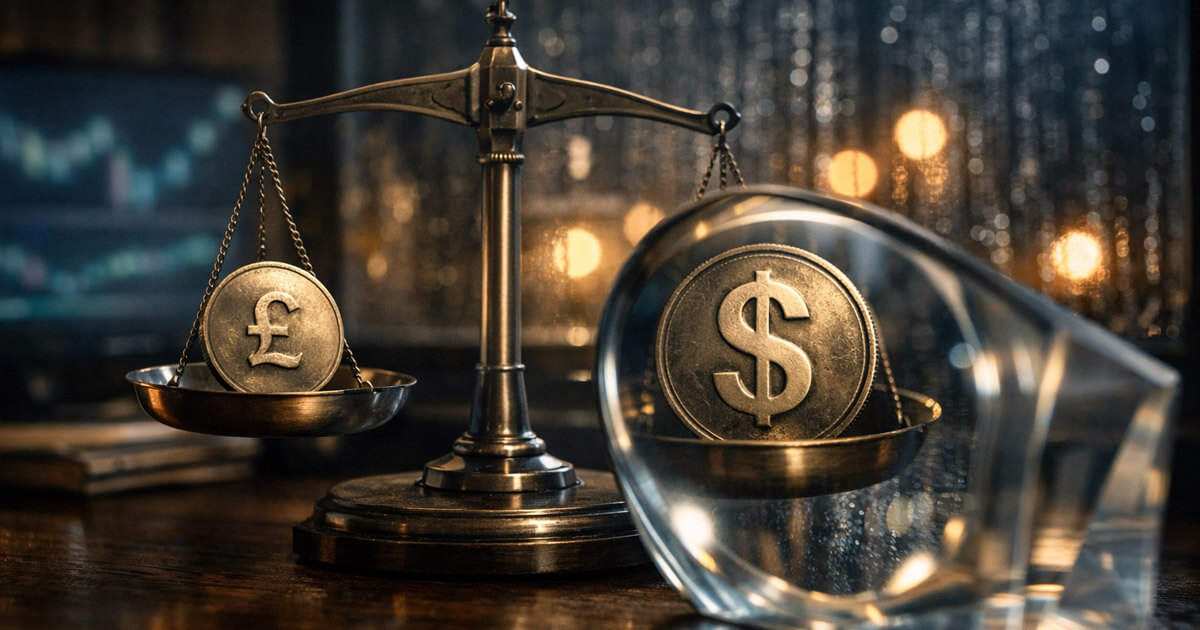
At first glance, the pound beating the dollar looks like one of the strangest charts in finance. For anyone raised on crypto, it feels even more confusing. The United States dominates global markets, the dollar powers trade and reserves, and most major assets are priced against USD. So when you see that one British pound still buys more than one U.S. dollar, your instinct is to assume something is broken. But the chart is not broken. The mental model is.
The Mistake Most People Make
The biggest misunderstanding comes from focusing on the unit instead of the pair. In crypto, people get trained to notice sticker price. A token trading at $1 can feel cheap or important, even though that number alone tells you almost nothing without supply, demand, and market cap. Foreign exchange works the same way. The number on the screen is not a national power ranking. It is simply the exchange rate between two units that were created at different times, under different systems, with different historical baggage.
That means £1 being worth more than $1 does not mean the U.K. is stronger than the U.S. It only means the market currently prices one pound above one dollar in that specific pair. The actual chart to watch is GBP/USD, not some imaginary scoreboard where every country’s currency unit eventually lines up in the same order as GDP, military influence, or global relevance.
Why Currency Units Are Weird by Design
Fiat currencies are not launched like tokens with a neat tokenomics page and a clean cap table. They are inherited systems. Their units are shaped by history, redenominations, political decisions, and old accounting structures that were never designed to make intuitive sense to modern traders. Nobody sits down every few decades and says, “Let’s resize the pound so it looks more logical next to the dollar.”
That is why comparing one yen, one pound, and one dollar as if they are equal-size building blocks leads people into confusion. They are not. They are labels attached to different monetary traditions. The label is arbitrary. The market price is what matters.
The Better Crypto Analogy
A smarter way to understand this is to treat GBP/USD like a crypto trading pair. When you look at ETH/BTC, you do not ask which chain is “supposed” to be worth more because one whole unit of one coin has a higher number than another. You understand that the price is driven by expectations, liquidity, credibility, demand, and relative positioning. The same logic applies here.
The pound can trade above the dollar while the dollar remains the dominant global currency. Those two facts can exist together without contradiction. Dollar dominance is about network effects, reserves, trade invoicing, debt markets, and settlement infrastructure. The GBP/USD quote is just the live market price between two currencies, not a verdict on which country runs the world.
What Actually Moves the Pair
Once you stop staring at the unit, the real drivers become much easier to understand. Interest rates matter because money tends to move toward yield. Inflation matters because markets care about which currency is likely to protect purchasing power better over time. Risk matters because investors flee toward safety when volatility rises. Capital flows matter because global money is always hunting for the best balance between return and trust.
That is why currencies can move sharply even when nothing dramatic changes in everyday life. Exchange rates are forward-looking. They trade on what investors expect central banks to do, how credible policymakers appear, and whether markets are leaning toward risk-taking or defense. In that sense, FX behaves a lot like crypto, except the narratives are built from macroeconomics rather than token unlocks and protocol upgrades.
Why “Buying Power” Is a Different Question
Many people use the phrase “worth more” when they really mean “what can this money buy me?” That is a different conversation. The FX rate tells you the market price of one currency against another. It does not tell you how expensive rent, food, transport, or energy feel inside each country. That is where purchasing power comes in.
A currency can look strong on the chart and still feel weak at home if local prices are high. On the other hand, a weaker-looking currency can sometimes stretch further in day-to-day life if domestic costs are lower. That is why tourists often feel confused. The exchange rate and real-world affordability do not always tell the same story.
Could the Dollar Overtake the Pound?
Yes, but not because history owes it that result. Parity would happen only if the market starts pricing dollars more aggressively relative to pounds. That could come from stronger U.S. yields, deeper global stress, rising demand for dollar liquidity, or a new loss of confidence in Britain’s fiscal or political outlook. In other words, the move would come from flows, expectations, and risk premiums, not from some grand moment where the dollar finally “deserves” to be higher.
That is the key lesson. Currencies do not care about what looks intuitive. Markets price what people want to hold, not what makes the cleanest headline.
Final Takeaway
For crypto-native readers, the cleanest conclusion is this: £1 buying more than $1 is mostly a unit illusion. The pound is not magically stronger in every sense, and the dollar is not weaker just because its unit is smaller. The real story lives in the pair, and the pair is driven by policy, inflation, rates, trust, and capital flows.
Once you stop treating currency units like scoreboards and start treating them like quoted assets, the “least intuitive chart on Earth” suddenly becomes much easier to read.
FAQs
Why is £1 worth more than $1?
Because currency units are historically defined and not standardized across countries. The pound’s higher unit value does not mean the U.K. is more powerful than the U.S.
Does this mean the British economy is stronger than the U.S. economy?
No. Exchange-rate unit value is not a ranking of economic power. It only reflects the current price of one currency against another.
Is GBP/USD similar to a crypto trading pair?
Yes. It is best understood as a relative market price, much like BTC/ETH or ETH/BTC, where expectations and flows matter more than the unit label.
Does a stronger currency always mean more purchasing power?
Not necessarily. A currency can look strong on the chart while everyday goods and services still feel expensive locally.
Can the dollar rise above the pound?
Yes. But that would happen because of changing market expectations, interest-rate differentials, global risk demand, or confidence shifts, not because there is some natural rule that says it must happen.