

A New Risk Hiding Behind the AI Boom
Bitcoin’s recent strength has encouraged a familiar belief that institutional demand is becoming deep, stable, and increasingly independent of outside market noise. But that confidence may be overstated. A growing body of evidence suggests Bitcoin is now tied far more closely to AI-driven equity sentiment than many holders want to admit. That matters because one disruption in the AI trade, especially around Nvidia and global chip supply, could quickly spill into broader risk markets and trigger a sharp wave of institutional de-risking that hits Bitcoin at the same time.
Why Nvidia Matters More to Bitcoin Than It Should
At first glance, Nvidia and Bitcoin seem to belong to different worlds. One is the centerpiece of the AI hardware boom, while the other is a decentralized monetary asset. But markets do not always trade assets based on what they are. They often trade them based on how institutions group them together. In 2025, Bitcoin’s correlation with the Nasdaq stayed above 0.5 for much of the year, showing that it was behaving less like isolated “digital gold” and more like part of a broader risk-on technology basket. When AI stocks rallied, Bitcoin often caught the same bid. When growth equities wobbled, Bitcoin frequently absorbed the same downside pressure.
The $54 Billion Nvidia Gamble
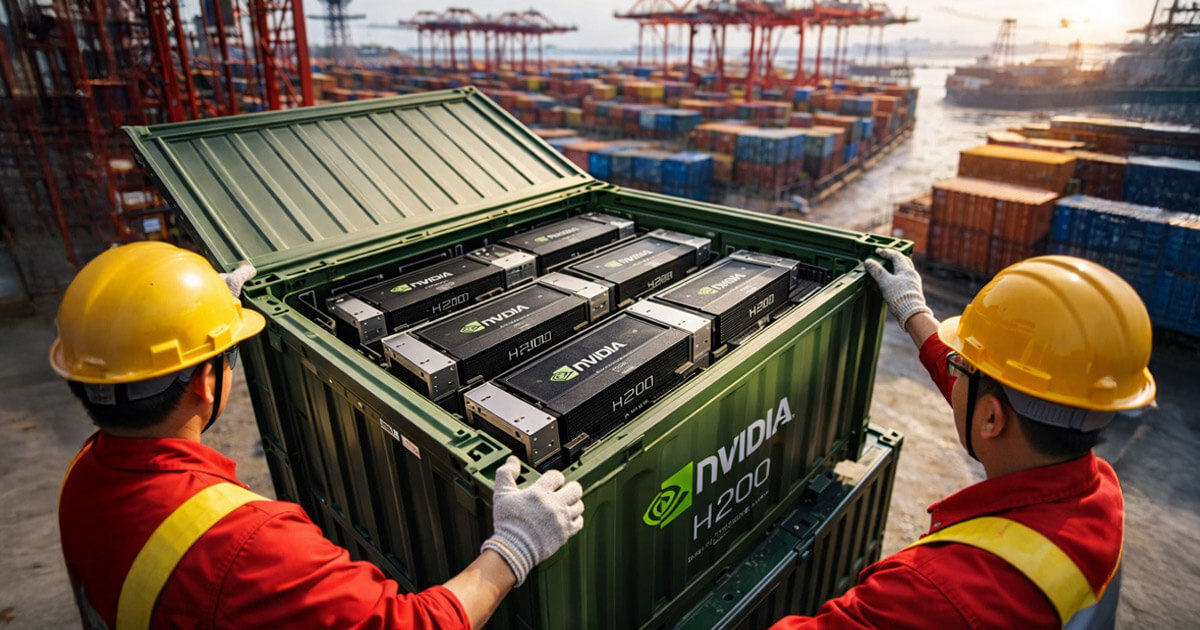
The immediate risk centers on reported pressure from Beijing for some Chinese technology firms to halt orders of Nvidia’s H200 chips. The scale of that demand is enormous. China had reportedly been preparing to receive more than 2 million H200 units in 2026, representing about $54 billion in gross chip value at an estimated $27,000 per unit. That demand is far larger than Nvidia’s reported available inventory of roughly 700,000 units. If those orders are delayed or canceled, the consequences reach well beyond one company’s revenue pipeline. The entire AI supply narrative starts to shift.
How an AI Shock Could Spill Into Bitcoin
This is where the problem becomes serious for Bitcoin. If Chinese demand weakens, Nvidia could potentially redirect supply to other regions, easing GPU scarcity outside China. That might sound helpful at first, but it would also reshape pricing, rental rates, and return expectations across the AI infrastructure economy. Because large institutions increasingly treat Bitcoin as part of the same macro risk framework that prices semiconductors and growth equities, a sudden repricing of AI optimism could feed directly into Bitcoin through portfolio risk budgets and ETF flows. In other words, Bitcoin does not need to depend on GPUs technologically to be hurt by a GPU-driven market sell-off financially.
Bitcoin Miners Make the Link Even Tighter
The relationship goes deeper than simple stock-market correlation. A growing number of publicly listed Bitcoin miners have expanded into AI infrastructure and data-center hosting, betting that AI workloads can generate better economics than pure Bitcoin mining under current power and hash-rate conditions. That means some of the companies most closely tied to Bitcoin’s ecosystem are now also exposed to GPU availability, utilization, and leasing economics. If the AI hardware market changes because China steps back or because supply conditions loosen globally, the value of these miner-turned-AI-host businesses could move sharply. That creates another channel through which AI market stress can flow back into crypto.
This Is Really About Institutional Positioning
The bigger lesson is that Bitcoin’s vulnerability here is structural, not emotional. Institutions no longer treat Bitcoin as a purely separate macro asset. They often place it inside the same broad allocation framework as technology, growth, and momentum-driven risk trades. That has helped Bitcoin benefit from periods of AI optimism and strong tech performance. But it also means Bitcoin can be sold quickly when those same institutions need to cut risk across portfolios. A wobble in Nvidia is not just a semiconductor story anymore. It can become a trigger for a much wider rebalance, and Bitcoin may be swept into that process whether or not anything about the Bitcoin network itself has changed.
Why the Sell-Off Risk Could Be Sudden
What makes this setup dangerous is speed. Crypto exchange-traded products absorbed $46.7 billion in 2025, making ETF flows a major short-term force in Bitcoin price action. If AI-related headlines create a risk-off move in tech, institutions do not need weeks to respond. They can cut exposure fast, and Bitcoin ETF flows can weaken or reverse just as quickly. That creates a feedback loop: tech sells off, institutions reduce risk, Bitcoin ETFs see weaker flows or outflows, and Bitcoin itself drops harder because it is now embedded in the same sentiment cycle.
A Strong Asset Can Still Be Caught in the Wrong Trade
None of this means Bitcoin is fundamentally broken. It means Bitcoin is being traded through a lens that may not reflect its original narrative. The market is rewarding it when AI optimism is strong and punishing it when tech sentiment weakens. That leaves Bitcoin in an awkward position. It can still benefit from institutional adoption, but that same adoption may be making it more exposed to shocks that start far outside crypto. The danger is not that Nvidia controls Bitcoin. The danger is that institutions now treat both as part of the same risk machine. And when that machine turns defensive, Bitcoin could face a sell-off that has little to do with Bitcoin itself.
FAQs
Why is Nvidia relevant to Bitcoin right now?
Because Bitcoin has been trading with elevated correlation to technology and AI-linked equities, so major Nvidia-related shocks can influence broader institutional risk appetite and spill into Bitcoin.
What is the $54 billion figure referring to?
It refers to the reported value of around 2 million Nvidia H200 chips that Chinese firms had been preparing to receive in 2026 at roughly $27,000 per unit.
How could an AI supply-chain problem hurt Bitcoin?
If AI stocks fall on regulatory or supply-chain headlines, institutions may cut risk across portfolios, and Bitcoin can be sold alongside tech due to shared allocation frameworks and ETF flow sensitivity.
Why do Bitcoin miners matter in this story?
Because several listed Bitcoin miners have expanded into AI hosting and data-center businesses, making part of the crypto ecosystem more directly tied to GPU economics.
Does this mean Bitcoin is no longer independent?
Not permanently, but in the current market regime it has been behaving more like a high-beta tech-linked risk asset than a fully separate store-of-value trade.