
Bitcoin Miners Are Chasing a New Business Model
Bitcoin miners have spent the past year trying to convince investors that they are no longer just mining companies. After the 2024 halving cut block rewards and made mining economics harder, many public miners began shifting their story toward artificial intelligence and high-performance computing. The idea was simple: miners already own energy-heavy sites, grid connections, land, cooling knowledge, and industrial infrastructure. If Bitcoin mining margins shrink during a bear market, those same assets could be used to serve AI companies that need huge amounts of power and data-center capacity.
That strategy made sense because AI demand has created a new kind of infrastructure race. The most valuable asset is not only the chip; it is the ability to power thousands of chips quickly. Bitcoin miners saw an opening because many of them already secured electricity before the AI boom made power scarce. But now Elon Musk’s infrastructure ecosystem has entered the same market with much deeper pockets, stronger technology links, and the ability to move at a scale most miners cannot easily match.
The AI Pivot Was Supposed to Protect Miners
For miners, the AI pivot became a bear market escape plan. When Bitcoin price falls, network difficulty rises, or hashprice drops, mining profits can shrink fast. Older machines become less efficient, power costs become more painful, and weaker operators struggle to survive. By turning mining sites into AI-ready infrastructure, miners hoped to create a second revenue stream that was not fully dependent on Bitcoin’s price.
This is why companies such as Core Scientific, TeraWulf, Cipher, Hut 8, IREN, and Bitfarms have attracted attention from investors. The market has started valuing some miners less as pure Bitcoin producers and more as energy and data-center infrastructure companies. Miners with high-performance computing contracts can receive stronger valuations because investors see them as part of the AI buildout. In a difficult mining cycle, that difference can decide which companies survive, raise capital, and grow.
Power Has Become the Real Trade
The biggest reason miners became attractive to AI firms is power scarcity. AI models require huge clusters of GPUs, but those chips are only useful if they can be installed in locations with enough electricity, cooling, and grid access. Building new data centers from scratch can take years because grid connections, transformers, substations, and permitting all create delays. Miners already understand large-scale energy operations, and many already sit on powered sites that can be upgraded.
This has changed how investors look at the sector. In the past, a miner’s value was tied mainly to Bitcoin production, hash rate, machine efficiency, and energy cost. Now, the question is whether the company owns scarce power capacity that can be converted into AI revenue. In that environment, a mining site may be valuable even if its Bitcoin mining operation is under pressure. The site itself becomes the asset.
Elon Musk Changes the Competitive Map
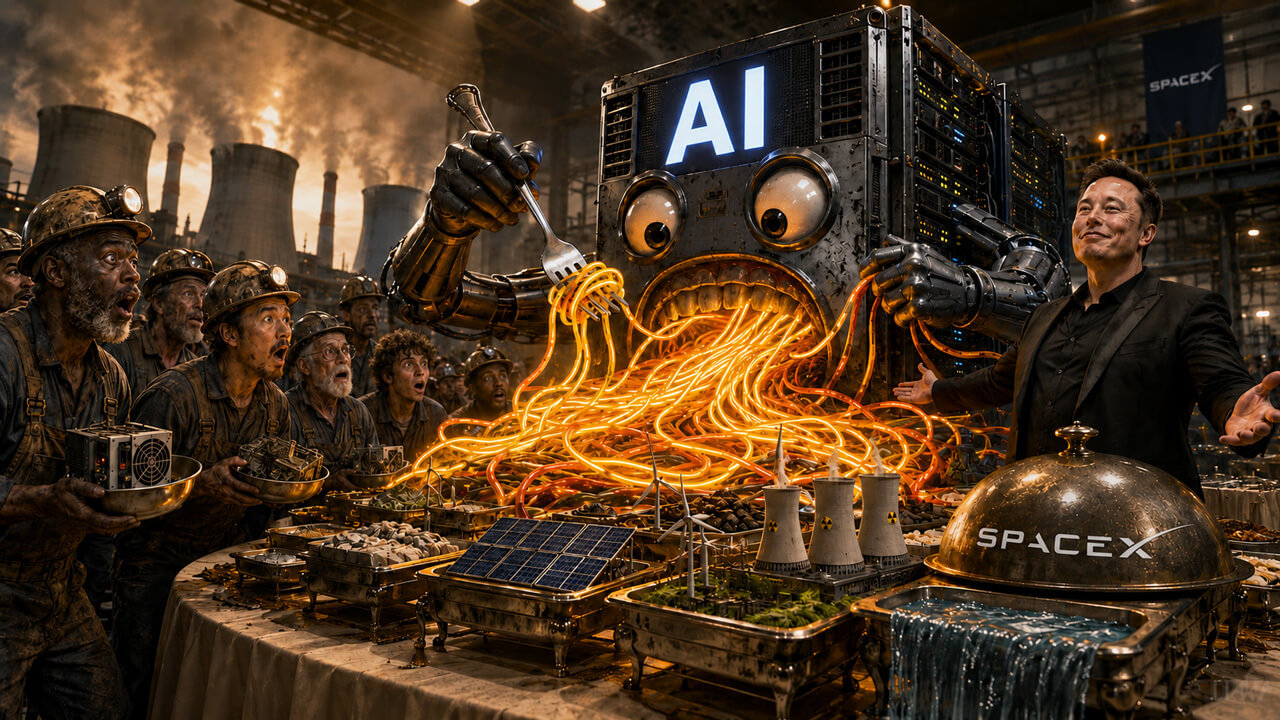
The new challenge is that miners are no longer competing only with each other. Elon Musk-linked infrastructure has shown that major technology platforms can also turn massive AI clusters into commercial compute products. The SpaceX-Anthropic deal around the Colossus 1 facility in Memphis highlights this shift. With access to hundreds of thousands of Nvidia processors and hundreds of megawatts of capacity, the project shows what miners are up against.
For Bitcoin miners, this is a serious competitive warning. A converted mining site may offer fast access to power, but Musk’s ecosystem can offer scale, capital, technology ambition, and major AI customers. That combination is much harder to match. If large technology platforms can build or reallocate compute capacity faster than miners can convert their facilities, the AI opportunity may become more competitive than miners expected.
Miners Still Have an Advantage
Even with Musk entering the race, Bitcoin miners are not out of the game. Their strongest advantage remains location and power access. Many miners operate in regions where they already have land, power agreements, and experience running energy-intensive operations. That gives them a time advantage over new data-center projects that are still waiting in grid queues. For AI companies that need capacity quickly, a miner with the right site can still be an attractive partner.
However, not every mining site can become an AI data center. AI workloads need different cooling, networking, reliability, and operational standards than Bitcoin mining. Mining machines can tolerate simpler infrastructure, while AI customers expect high uptime, dense power delivery, and professional data-center design. This means miners need capital and execution skill, not just cheap electricity.
The Sector Is Splitting Into Two Groups
The AI boom is creating a clear divide inside the Bitcoin mining industry. One group is becoming infrastructure-first, using mining as only one part of a broader data-center strategy. These companies may benefit from AI contracts, higher valuation multiples, and more stable long-term revenue. The other group remains tied mainly to Bitcoin mining economics, meaning its future depends more directly on BTC price, hashprice, and network difficulty.
This split will likely become more important in the next bear market. Miners with strong AI partnerships may be able to survive low Bitcoin prices better than pure-play miners. But they will also face competition from hyperscalers, neocloud operators, energy developers, infrastructure funds, and Musk-style technology platforms. The AI pivot is not a free escape route. It is a new battlefield.
Final Thoughts
Bitcoin miners turned to AI because the bear market exposed how fragile mining profits can become after a halving. Their power-heavy sites suddenly looked like valuable infrastructure for an AI economy that cannot get electricity fast enough. But Elon Musk’s entrance shows that the same opportunity is attracting far stronger competitors. Miners still have a real advantage in powered land and grid access, but they must prove they can convert those assets into reliable, high-performance AI infrastructure. The future of mining may no longer be only about producing Bitcoin. It may be about who controls power, who can deliver compute, and who can move fastest before the biggest technology players take the best customers.
FAQs
Why are Bitcoin miners moving into AI?
Bitcoin miners are moving into AI because mining profits became harder after the halving and falling hashprice pressure. AI and high-performance computing offer miners a second revenue stream by using their power-heavy sites for data-center demand.
Why is Elon Musk a new rival for Bitcoin miners?
Elon Musk is a new rival because his infrastructure ecosystem can offer massive AI compute capacity, deep capital, strong technology links, and major customers. That makes it harder for miners to compete only on power access.
What advantage do Bitcoin miners still have?
Bitcoin miners still have an advantage because many already control powered sites, land, grid connections, and energy operations. These assets can be valuable when AI companies need capacity faster than new data centers can be built.
Can AI save Bitcoin miners in a bear market?
AI can help some miners survive a bear market, but it will not save every company. Only miners with strong sites, capital, technical upgrades, and real AI contracts are likely to benefit from the shift.