
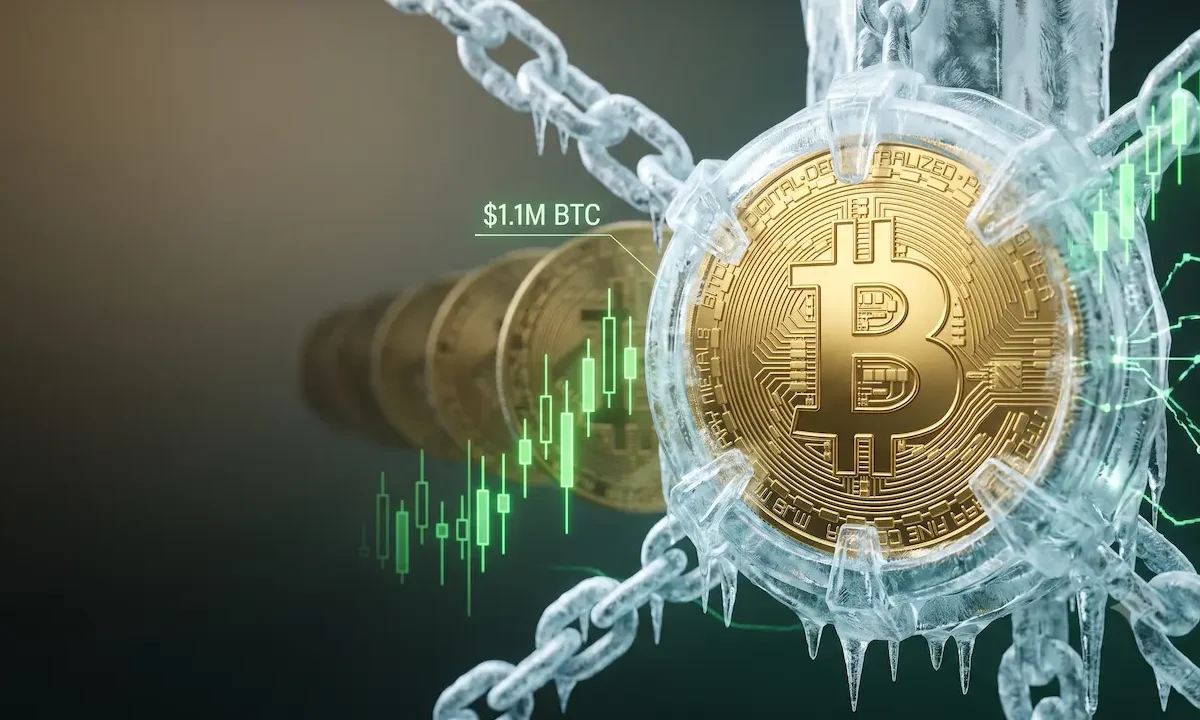
The dead-key alliance theory argues that the roughly 1.1 million bitcoin tied to Satoshi Nakamoto will never move, even as several Satoshi-era wallets have quietly reactivated in 2026.
The claim is not that one person guards the stash. It is that several separate forces, technical, financial, and ideological, now push in the same direction and keep it frozen. On-chain researchers have mapped the holdings, dated their dormancy, and modeled what a sudden move would do, and their work explains why the theory has held up.
What the on-chain data actually shows
Blockchain forensic analysis has traced roughly 1.09 million to 1.1 million bitcoin to Satoshi, about 5.47% of Bitcoin’s fixed 21 million supply, according to Bitcoin.com News. The coins sit across an estimated 22,000 addresses, each holding exactly 50 BTC from early block rewards.
Most of that mapping rests on the Patoshi Pattern, identified by researcher Sergio Demian Lerner, who published his first findings in 2013 and updated them in 2020. Lerner studied the ExtraNonce field and nonce distribution across the first 50,000 blocks and found one miner producing steep, regular patterns that pointed to a single custom setup. That signature disappears around block 54,000 in late 2010, which lines up with Satoshi’s exit from the project.
The transaction record is just as quiet. Satoshi sent 10 BTC to cryptographer Hal Finney on January 12, 2009, nine days after the genesis block. The last known outflow, a 32.51 BTC transfer to developer Mike Hearn, happened about 16 years ago. A final email in April 2011 said Satoshi had “moved on to other things,” and the Patoshi coins have not moved since.
Why the dead-key alliance holds
Three explanations dominate the debate among researchers and long-term holders, and each one reinforces the others.
- Lost keys: in 2009, bitcoin had no market value and no standard key management, so private keys on an old hard drive could have been deleted or lost before anyone cared.
- Death: if Satoshi was one person who has since died, the keys may be gone for good. Early contributors such as Hal Finney and cypherpunk Len Sassaman, both deceased, are sometimes named in this context.
- Ideological choice: a third view holds that Satoshi is alive and simply refuses to move the coins, protecting Bitcoin’s decentralization story by never cashing out.
This is where the dead-key alliance framing earns its name. Whether the keys are lost, gone with their owner, or deliberately untouched, the outcome is identical. The market has spent years treating this supply as if it does not exist, so the incentive to keep it still now reaches far beyond Satoshi.
What a single move would trigger
If any coins from the Patoshi cluster were spent, the impact would be immediate and severe, according to Bitcoin.com News. The move would erase a widely held assumption that this 5.47% of supply is permanently out of circulation, introducing a liquidity shock and a likely hit to confidence. It could also surface fresh clues about Satoshi’s identity.
That fear is not abstract. Older dormant wallets have started to wake up. A Satoshi-era wallet untouched since August 2010 moved 20 BTC on May 31, 2026, ending 15.8 years of dormancy, as Galaxy Research flagged in block 951828. Those coins were worth about $1.47 million at the time. None belonged to the Patoshi cluster, but each reactivation tests the assumption the market leans on.
The new pressure of quantum risk
A separate threat has entered the conversation. Researchers at AmericanFortress told CoinDesk in May 2026 that Satoshi’s 1.1 million bitcoin, plus nearly 5 million more in other dormant accounts, worth about $400 billion combined, could eventually be exposed to quantum attacks. The company proposed a post-quantum signature scheme and a soft fork to freeze and protect dormant coins.
That proposal speaks directly to the core question. If the keys are truly dead, the coins cannot defend themselves, so the network itself may have to decide whether to shield them. CEO Michal Pospieszalski said dormant wallets do not have to stay vulnerable to attackers who could sweep the funds and dump them on the market.
For now the coins stay where they have always been, mapped and visible on the public ledger, yet unreachable by anyone but whoever, if anyone, still holds the keys. The dead-key alliance does not need a plan or a person. It only needs that no key ever signs.
Frequently Asked Questions
How much bitcoin does Satoshi hold?
On-chain forensic analysis estimates roughly 1.09 million to 1.1 million BTC, about 5.47% of the 21 million supply, spread across around 22,000 addresses of 50 BTC each.
Why has the dead-key alliance kept the coins still for so long?
Whether the keys are lost, belong to someone who has died, or are held by someone choosing not to spend, the result is the same, and the market now benefits from the supply staying frozen.
When did Satoshi’s coins last move?
The last known outflow was a 32.51 BTC transfer to developer Mike Hearn about 16 years ago, and Satoshi’s final public email came in April 2011.
What would happen if the coins moved today?
Analysts expect an immediate liquidity shock, a likely drop in confidence, and possible clues to Satoshi’s identity, because the market treats this supply as permanently out of circulation.
This article is for informational purposes only and is not financial advice. Always do your own research before making any investment decision.